New Cars
 Used Cars
 Rentals
 Boats
Boats Motorbike
 Utility
 Services
 News & Review
Why Do Some Boats Carry So Many Engines? The Real Reason Is Not Speed
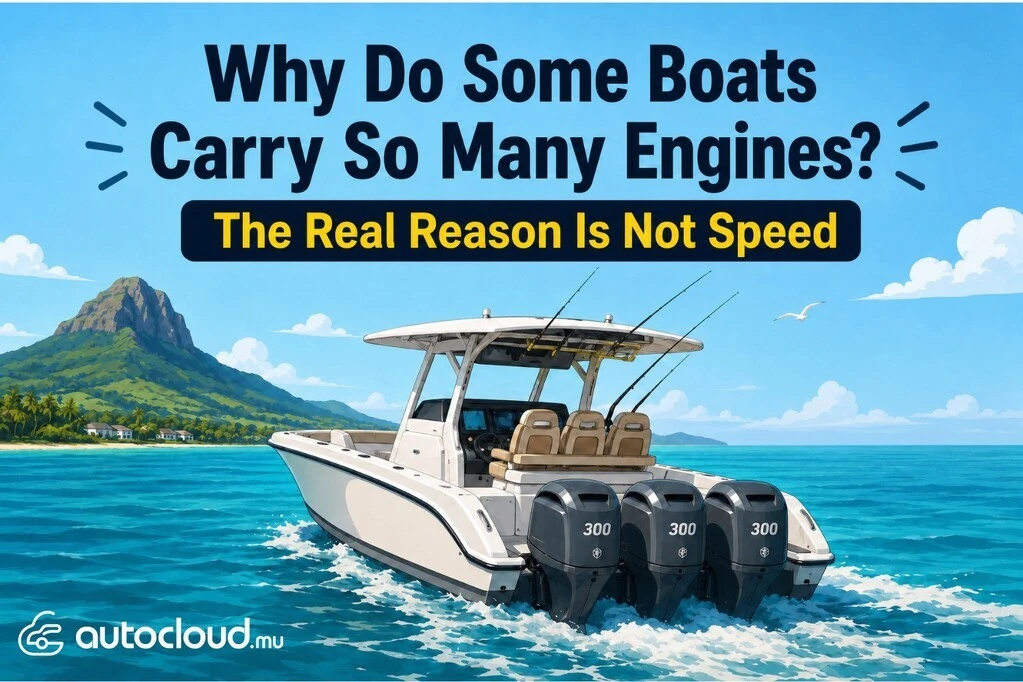
At first glance, a boat with five outboard engines bolted to the transom looks like pure showing off. You would assume it is all about going fast. It is not. The real reasons are far more practical, and once you understand them, five engines starts to make complete sense. Single outboard engines hit a hard limit. Right now you cannot buy a single outboard bigger than 600 horsepower anywhere in the world. The most powerful in production is the Mercury V12 Verado, launched in early 2021. Yamaha's largest is the XTO Offshore 450, and Suzuki tops out at 350. So the moment a boat is big enough to need more than 600 horsepower, builders have no real choice. They add a second engine. Once that door is open, three, four, five and even six engines start turning up on the same hull. You might ask why builders do not simply make one enormous engine instead. The answer is physics. A single huge propeller wants to twist the boat sideways, an effect known as torque steer, and the harder you push it the more the boat fights back. Propellers also lose their grip at extreme power, as air bubbles form and thrust drops away. Bolting on a second engine sidesteps all of that. It is easier, more reliable and far more controllable than chasing one monster powerplant. This is the reason that matters most. Offshore, the ocean does not care about you. A single engine failure 100 miles from land can turn into a life or death situation very quickly. Multiple engines give boaters what they call the get home principle. Lose one, keep going. On many big offshore boats you can lose two engines and still make it back to the dock safely. That single fact has almost certainly saved thousands of lives, and it is why serious offshore fishing boats look so extreme. The design is not about the marina on a Saturday afternoon. It is about bringing the crew home no matter what breaks. More engines also make a big boat far easier to handle. Twin outboards let you spin a boat on the spot at the dock, pushing one forward while the other runs in reverse, something a single engine simply cannot do. Modern joystick piloting takes this further. Each engine steers, shifts and throttles on its own, working together to slide the boat sideways or hold it in place against the wind. Thanks to that technology, an ordinary owner can dock a 50 foot, six engine boat without ever touching the wheel. There is a structural benefit too. Two or three engines spread their weight across the back of the hull rather than concentrating it in one spot. That changes how the boat sits in the water and how it turns, which matters more and more as boats get longer and heavier. Here is the part that surprises people. You would assume more engines always means more fuel burned. At full throttle, yes. But most of these boats are cruised at around 40% throttle, not flat out, and cruising revs are where the real economy lives. Sometimes fewer, bigger engines win on fuel. Sometimes more, smaller engines let you cruise at lower revs and save fuel that way. It depends on the boat and the mission, which is exactly why builders now think so carefully about how many engines to fit. Strip away the spectacle and the lesson is simple. These boats are not over engineered for the sake of it. Every engine earns its place, whether for power, safety, control or economy. It all comes down to matching the vessel to the journey ahead. AtAutoCloud.mu you can browse and compare boats alongside the rest of the marketplace, and find something that suits the way you actually get out on the water. So, how many engines would you put on your dream boat? Whatever the answer, make sure the boat behind them is the right one for the trip.The 600 horsepower ceiling
One giant engine is an engineering nightmare
Redundancy: the get home principle
Control and manoeuvrability
Spreading the load
The fuel economy twist
The right machine for the mission
More Articles
![Never Miss the Right Vehicle: Set Up Email Alerts]()
Never Miss the Right Vehicle: Set Up Email Alerts
New listings are added to AutoCloud.mu every day, and the good ones often go fast. Email Alerts do the ...Read more![The Strait of Hormuz Crisis and Your Fuel Bill What Mauritian motorists need to know right now]()
The Strait of Hormuz Crisis and Your Fuel Bill What ...
If you've recently driven past a filling station and enjoyed the fact that prices haven't moved much yet, don't get ...Read more