New Cars
 Used Cars
 Rentals
 Boats
Boats Motorbike
 Utility
 Services
 News & Review
The Strait of Hormuz Crisis and Your Fuel Bill What Mauritian motorists need to know right now
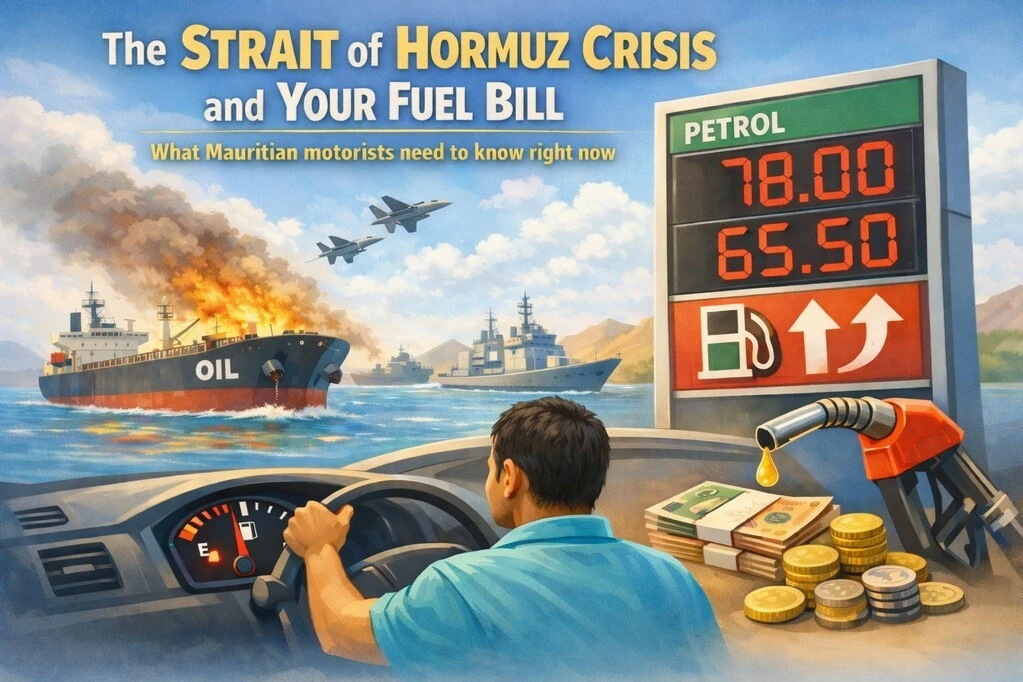
If you've recently driven past a filling station and enjoyed the fact that prices haven't moved much yet, don't get too comfortable. The conflict between the US, Israel, and Iran that escalated in early 2026 isn't just a faraway geopolitical story. For Mauritian motorists, it may not have reached the pump just yet, but the signs are there that it's only a matter of time.
Here's why, and what it means for you.
It all comes down to one stretch of water
The Strait of Hormuz is a narrow channel, just 33 kilometres wide at its tightest point, sitting between Iran and Oman. About 20 per cent of the world's oil passes through it every single day. When the conflict escalated in late February 2026, tanker traffic through the Strait dropped from roughly 24 ships per day to just four. Around 200 oil tankers were left stranded in the Gulf, unable to move safely.
Oil markets reacted within hours. Brent crude jumped sharply, and analysts at Goldman Sachs, JPMorgan, and Deutsche Bank began revising their forecasts upward, with some worst-case scenarios reaching $120 to $200 per barrel if the disruption drags on.
Why Mauritius feels this more than most
Mauritius has no oil of its own. Every drop of petrol and diesel on the island is imported, which means when global prices spike, there's nowhere to hide. Fuel imports run at around USD 1.3 billion a year and account for roughly 21 per cent of all merchandise imports. It doesn't take long for a global shock to show up locally.
The government does have a buffer in place, the Price Stabilisation Account, which is designed to absorb some of the volatility before it reaches the pump. But the diesel side of that fund was already around Rs 2.5 billion in deficit before this crisis even began. That's less cushion than we'd ideally want heading into a sustained period of high oil prices.
As of late February 2026, petrol sat at Rs 58.45 per litre and diesel at Rs 58.95. Those prices were set when conditions were considerably calmer.
It won't just be the pump
A fuel price rise in Mauritius doesn't stay at the forecourt. Buses, lorries, and delivery vans all run on diesel. When their costs go up, so does the price of everything they carry or support. Groceries, taxi fares, restaurant meals, and electricity bills can all feel the knock-on effect.
And here's the thing: the island is already feeling it. The cost of shipping goods to Mauritius is rising because the cargo vessels that bring in everything from electronics to food staples run on bunker fuel, which is directly tied to crude oil prices. When freight costs go up, importers pay more to get stock onto the island, and that cost quietly finds its way into the price tag of goods on the shelf. You may not see it at the pump first. You might notice it at the supermarket checkout before you ever notice it at the filling station.
Tourism is another area to watch. Jet fuel prices move with crude, and higher aviation costs tend to filter through to airline surcharges and package prices, which matters enormously for an island economy that depends on visitors arriving from Europe and beyond.
What's being done about it
The government is working to revive a direct petroleum supply deal with India, which would give Mauritius access to competitively priced refined fuel without going through the most volatile parts of the market. It's a sensible move and one that could take some pressure off, though it won't make Mauritius immune to what's happening globally.
What does this mean for you?
If prices do rise at the pump, even a Rs 5 to Rs 10 increase per litre adds up quickly, especially if you're running two vehicles or a small business fleet. It's worth thinking now about your vehicle's fuel efficiency, whether your servicing is up to date, and whether your current car still makes sense from a running cost perspective.
At AutoCloud.mu, we factor fuel costs into everything we do, from vehicle valuations to total cost of ownership insights. If the current situation has you rethinking your vehicle or your fleet, we're here to help you make that call with real data behind it.
The situation in the Strait of Hormuz is still developing. Nobody knows exactly how it plays out. But the time to think about your fuel costs is before the next price review, not after.
More Articles
![The Roadblock Lottery: Why One in Four Drivers Lost This Weekend]()
The Roadblock Lottery: Why One in Four Drivers Lost This ...
If you were out on the roads between Saturday 3 and Monday 5 October, there is a good chance you met a ...Read more![Skip the Queue: Traffic Fines Go Online From 30 October]()
Skip the Queue: Traffic Fines Go Online From 30 October
Few things sour a morning quite like a Fixed Penalty Notice. Until now, settling one has usually meant taking time ...Read more![The Road Traffic (Amendment) Act 2026: What Has Changed and What It Means for You]()
The Road Traffic (Amendment) Act 2026: What Has Changed and What ...
When we last covered this, the new road traffic measures were still proposals. They are now law.The Road Traffic (...Read more