New Cars
 Used Cars
 Rentals
 Boats
Boats Motorbike
 Utility
 Services
 News & Review
Slow Down, Save Money: Fuel-Saving Tips for a World Paying More at the Pump
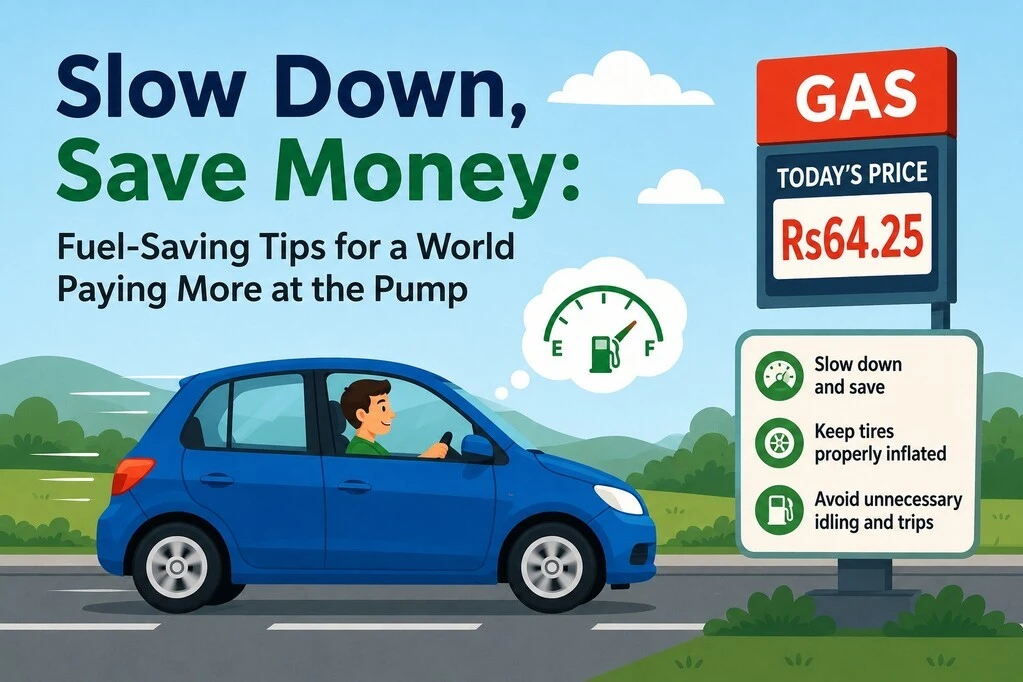
Fuel prices are climbing again, and this time the reasons stretch well beyond our shores. Ongoing tensions around the Strait of Hormuz, through which roughly 20% of the world's oil supply passes, have squeezed global crude supply and pushed prices upward. That pressure, as it always does, trickles down to us, the ordinary driver filling up on a Tuesday morning. The good news is that driving more economically is entirely within our control, and it happens to make the roads safer and more pleasant for everyone in the process. The single most effective change you can make is also the simplest: drive smoothly. Aggressive acceleration followed by hard braking can reduce fuel economy by between 10% and 40% in stop-and-go traffic, according to research from the US Department of Energy. The fuel spent lunging forward is largely wasted the moment the brakes go on. Look further ahead, ease off the accelerator early when traffic is slowing, and let the car coast. Your fuel consumption drops, your brakes last longer, and the whole journey becomes noticeably calmer. The road tends to reward patience rather more than it rewards urgency. Fuel consumption rises sharply with speed due to aerodynamic drag. Driving at 120 km/h instead of 100 km/h uses roughly 20% more fuel, often for a time saving that amounts to just a few minutes on a typical journey. Staying at appropriate speeds is one of the easiest ways to stretch a tank further, and it gives you considerably more time to react to the unexpected. Idling quietly burns through your fuel with nothing to show for it. A typical three-litre engine wastes around 300 millilitres of fuel for every 10 minutes it sits running. Waiting to pick someone up, parked at the side of the road, or stuck in a queue that has genuinely stopped moving? Turn the engine off. Under-inflated tyres increase rolling resistance, which means the engine works harder for the same result. A five-minute tyre pressure check, using the figures in your vehicle handbook, can make a quiet but meaningful difference to efficiency. Similarly, removing roof racks when not in use and clearing unnecessary weight from the boot are small habits that add up over time. Plan Smarter Journeys Combining short trips into one well-planned outing is more economical than making several separate journeys, since a cold engine uses more fuel than a warm one. Avoiding peak congestion where possible also reduces the amount of time spent idling and accelerating from standstill, both of which are costly habits. On an island like Mauritius, a little forward planning can take a surprising amount of friction out of the day. Rising fuel prices are a reminder that the automotive world moves quickly, and staying on top of it matters. At AutoCloud.mu, we are committed to keeping everyday Mauritians informed on everything automotive, from the latest industry news to guides just like this one. Whether you are looking to buy or sell a vehicle, explore finance and insurance options, or get an accurate valuation on your current car, everything you need is in one place. The forces pushing up fuel prices are thousands of kilometres away and entirely outside our control. But the road in front of you, and how you choose to drive it, is entirely yours. A smoother, more considered approach costs nothing to adopt, saves money from the first journey, and makes the road a little more civilised for everyone sharing it. Visit AutoCloud.mu for more automotive insights, vehicle listings, and everything you need to navigate the road ahead.Drive Smoothly, Not Frantically
Mind Your Speed
Switch Off When Stationary
Check Your Tyres and Lighten the Load
Staying Informed is Half the Battle
More Articles
![The Road Traffic (Amendment) Act 2026: What Has Changed and What It Means for You]()
The Road Traffic (Amendment) Act 2026: What Has Changed and What ...
When we last covered this, the new road traffic measures were still proposals. They are now law.The Road Traffic (...Read more![Up, Down or Holding? The Honest Outlook for Fuel Prices]()
Up, Down or Holding? The Honest Outlook for Fuel Prices
Scroll through the local press this month and you could be forgiven for bracing yourself at the pump. Headlines have ...Read more![Speed Limits and Drink-Driving Limits in Mauritius: A Quick Guide for Drivers]()
Speed Limits and Drink-Driving Limits in Mauritius: A Quick Guide ...
Knowing the limits on Mauritian roads is the simplest way to stay safe, avoid a fine and keep your licence. ...Read more