New Cars
 Used Cars
 Rentals
 Boats
Boats Motorbike
 Utility
 Services
 News & Review
A brutal start to 2026 on Mauritian roads
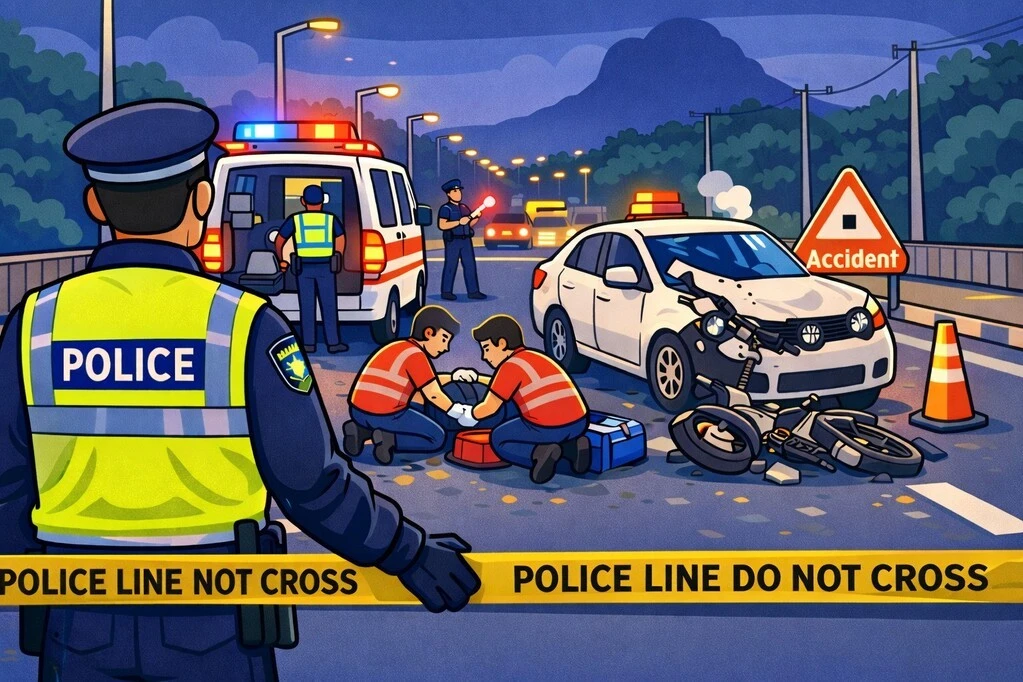
The opening weeks of 2026 have already brought sobering news for road safety in Mauritius.
As of 16 January, ten people had lost their lives in nine road accidents since the start of the year. This is double the number recorded over the same period in 2025. The incidents involved a mix of road users, including motorists, pedestrians and two-wheel riders, highlighting that risk on Mauritian roads is not limited to one group.
While early-year statistics can fluctuate, the increase is significant enough to prompt renewed reflection on how road safety is understood, practised and prioritised across the country.
A shared road environment with shared risk
One of the most striking aspects of the early 2026 figures is the spread of victims. Fatalities have occurred across vehicles, motorcycles and pedestrians, suggesting that the issue extends beyond isolated behaviours.
Mauritian roads bring together fast-moving vehicles, vulnerable road users, uneven infrastructure, and growing traffic volumes. In this environment, small lapses in judgement can have serious consequences. When incidents affect such a broad range of users, it points to a need for better alignment between how roads are used and how risks are perceived.
Enforcement alone does not address every factor
Police enforcement remains a visible and necessary part of road safety efforts. Regular patrols and checks aim to reduce speeding, impaired driving and other high-risk behaviour.
However, the persistence of serious accidents indicates that enforcement on its own may have limited long-term impact. International road safety research consistently shows that lasting improvements are most effective when policing is supported by strong road safety awareness and education. When drivers understand not only what the rules are, but why they exist, safer habits are more likely to follow.
This places renewed attention on awareness. Not in the sense of blame, but in recognising that many everyday driving decisions are shaped by habit, perception of risk, and understanding of consequences.
Where the penalty points system fits into the picture
Mauritius is preparing for the reintroduction of a penalty points system, designed to encourage accountability and discourage repeat offences. Such systems are widely used internationally and are most effective when they are clearly communicated and well understood by the driving public.
Penalty points are not a standalone solution, but they can reinforce safer behaviour when drivers are fully aware of how the system works and what actions carry consequences. Without that understanding, the deterrent effect can be diluted.
For readers interested in how penalty points systems have performed elsewhere, and what lessons may apply locally, we explore this in more detail in a dedicated article here:
Will Penalty Points Make Mauritius’ Roads Safer This Time?
Vehicle condition remains part of the safety equation
Beyond behaviour, vehicle condition continues to play a role in accident outcomes. Tyres, brakes, lighting and suspension directly affect control and stopping distances, particularly in unexpected situations.
In a market where many vehicles change hands, transparency around condition matters. Platforms such as AutoCloud.mu help motorists compare vehicles and make informed decisions, allowing safety considerations to form part of the buying and selling process rather than an afterthought.
Practical steps drivers can take
While broader solutions sit at policy and infrastructure level, individual choices still matter and can be acted on immediately.
Reduce speed in residential areas and near pedestrian zones
Avoid mobile phone use while driving
Ensure tyres, lights and brakes are properly maintained
Plan transport in advance when alcohol may be involved
These actions may seem small, but applied consistently, they reduce risk for everyone sharing the road.
Looking ahead
The early 2026 road toll is a reminder that road safety remains an ongoing challenge in Mauritius. Progress is rarely driven by a single measure. It is shaped by how enforcement, awareness, vehicle condition and personal responsibility interact over time.
As the year unfolds, continued attention to driver awareness and understanding will be just as important as visible enforcement. Fewer accidents begin not only with rules on paper, but with everyday decisions made behind the wheel.
More Articles
![The Roadblock Lottery: Why One in Four Drivers Lost This Weekend]()
The Roadblock Lottery: Why One in Four Drivers Lost This ...
If you were out on the roads between Saturday 3 and Monday 5 October, there is a good chance you met a ...Read more![Skip the Queue: Traffic Fines Go Online From 30 October]()
Skip the Queue: Traffic Fines Go Online From 30 October
Few things sour a morning quite like a Fixed Penalty Notice. Until now, settling one has usually meant taking time ...Read more![The Road Traffic (Amendment) Act 2026: What Has Changed and What It Means for You]()
The Road Traffic (Amendment) Act 2026: What Has Changed and What ...
When we last covered this, the new road traffic measures were still proposals. They are now law.The Road Traffic (...Read more