New Cars
 Used Cars
 Rentals
 Boats
Boats Motorbike
 Utility
 Services
 News & Review
Understanding the Penalty Points System in Mauritius: A Driver's Guide
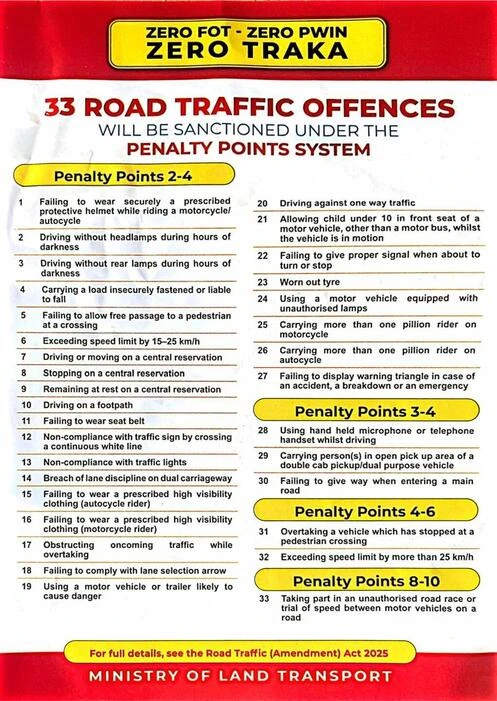
Mauritius has officially introduced a penalty points system for road traffic offences, marking one of the most significant changes to local road safety enforcement in recent years. The system is part of a broader Zero Fot Zero Pwin Zero Traka campaign and is designed to discourage repeat offences by linking unsafe driving behaviour directly to a driver's licence status. Here is a clear, practical breakdown of how the system works and what it means for motorists. In force since 31 January 2026, the system starts every driver at zero. When you commit one of the offences listed in the Third Schedule of the Road Traffic Act, points are added to your record, on top of whatever fine or sentence applies. Those points are not a replacement for the fine. They sit alongside it. Each allocation stays on your record for up to 36 months, then drops off, unless it has already been used to trigger a disqualification. The system applies to a full driving licence, a provisional licence and an international driving permit alike, so visitors and foreign residents are in it too. The licensing officer keeps a running tally for every driver. The number you cannot cross depends on the licence you hold. Cross that ceiling and you face disqualification. For provisional holders the margin is deliberately tight, which is the point: newer drivers are held to a stricter standard while their habits are still forming. The same offence can cost you a different number of points depending on how it is dealt with. Settle a Fixed Penalty Notice, or a Photographic Enforcement Device Notice from a camera, and you generally attract the lowest number in the offence's range. Let the case go to Court, and on conviction the Court can allocate points anywhere within the range, up to the higher end. In other words, contesting a straightforward fine can leave you worse off on points than if you had simply paid. The revised system covers 33 offences. Most carry a modest 2 to 4 points, but a handful hit much harder. Here is the full list, with point ranges and fines. The phone offence, number 28, is the one that catches ordinary, otherwise careful drivers. At up to 10 points on a Court conviction, a single glance at a handset can put a provisional driver over the edge in one go, and take a full licence holder two thirds of the way there. This is a plain-language summary. The Third Schedule of the Road Traffic Act remains the authority on the exact wording. Exceeding your maximum is not a warning. It carries real consequences. A full licence holder faces disqualification of 6 to 12 months. A provisional licence can be cancelled outright, with the same 6 to 12 month disqualification. An international permit holder is barred from driving in Mauritius for the same period. There is more. The Court will order a disqualified driver to complete an approved rehabilitation course. The licence or permit must be surrendered as soon as possible, and no later than five days after the order. And if you earn a second disqualification for offences committed within 36 months of the first one expiring, the Court cancels your licence altogether. Yes, but the window is narrow and it is not for everyone. A full licence or international permit holder who has accumulated at least 10 but no more than 14 points can apply to the Court to redeem up to three points, after completing a rehabilitation course. It is a one-off relief valve for a driver who is close to the edge but not yet over it. Provisional licence holders do not get this option. You do not need to guess where you stand. Drivers can view their licence details and accumulated penalty points through the KOREK! app, using MauPass to log in. Checking it now and then is worth the minute it takes, particularly if you have picked up a fine or two in the past three years and are not sure what has expired. Some of these offences are about how you drive. Others are about what you drive. A worn tyre, an insecure load, unauthorised lamps: each carries points, and each comes down to the condition of the vehicle under you rather than a moment's lapse at the wheel. Keeping a roadworthy car is no longer just about safety and resale value. It is now part of protecting your licence. If you are weighing up a change,AutoCloud.mu lets you compare vehicles across condition, age and specification, so your next car starts its life with you in good shape rather than one inspection away from a fine. The points system rewards drivers who take the whole picture seriously, and the vehicle is a bigger part of that picture than most of us think.The basic mechanics
Your ceiling
Fixed penalty or Court: it changes the count
The offences that cost you most
What happens if you go over
Can you claw points back
How to check your points
The quieter takeaway
More Articles
![The Roadblock Lottery: Why One in Four Drivers Lost This Weekend]()
The Roadblock Lottery: Why One in Four Drivers Lost This ...
If you were out on the roads between Saturday 3 and Monday 5 October, there is a good chance you met a ...Read more![Skip the Queue: Traffic Fines Go Online From 30 October]()
Skip the Queue: Traffic Fines Go Online From 30 October
Few things sour a morning quite like a Fixed Penalty Notice. Until now, settling one has usually meant taking time ...Read more![The Road Traffic (Amendment) Act 2026: What Has Changed and What It Means for You]()
The Road Traffic (Amendment) Act 2026: What Has Changed and What ...
When we last covered this, the new road traffic measures were still proposals. They are now law.The Road Traffic (...Read more