New Cars
 Used Cars
 Rentals
 Boats
Boats Motorbike
 Utility
 Services
 News & Review
An opinion on modern car features we probably did not need
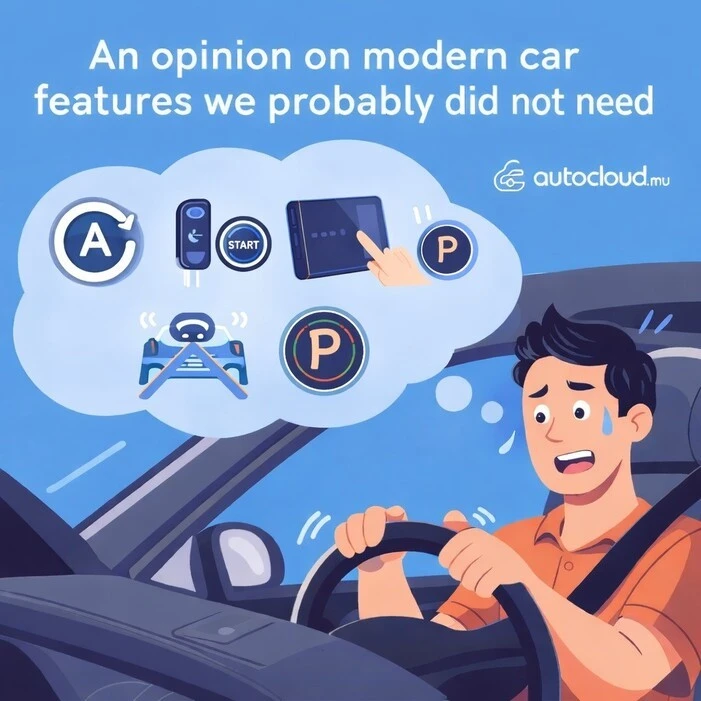
This is an opinion piece. It is not an argument against modern cars, nor an attempt to discourage the purchase of vehicles equipped with modern technology. Most of these features are unavoidable today, driven by regulation, design trends, or the pressure to appear innovative.
What follows is a look at five modern car features that are increasingly common, yet arguably add little to the real-world driving experience. This is not about nostalgia for the sake of it, but about questioning whether every new idea genuinely makes driving better.
Electronic handbrake
The electronic handbrake replaces a simple mechanical lever with a switch, a motor, and a set of rules decided by software. In doing so, it removes feel, immediacy, and a sense of control.
A traditional handbrake was intuitive and predictable. It did exactly what the driver asked, when they asked it. Modern electronic systems often decide for themselves whether an action is allowed. In many cars, pulling the switch while moving will either do nothing or trigger a managed deceleration rather than acting as a true mechanical backup. That may be safer on paper, but it removes a layer of direct control that drivers once had.
Across the board, it feels like a solution to a problem that did not exist.
Lane assist
Lane assist works well in ideal conditions. Straight roads, clear markings, predictable traffic. Outside of that environment, its limitations become obvious.
On poorly maintained roads or when actively avoiding potholes, lane assist can fight the driver’s steering input, attempting to pull the car back toward lines that may no longer be relevant .A system intended to keep a car safely centred can end up tugging the steering wheel back toward hazards it does not understand.
The concept is not entirely flawed. As a driver-selectable aid on long motorway journeys, it makes sense. As a default system that assumes it knows best at all times, it does not. This is one feature that should be off by default and switched on only when conditions suit it.
Touchscreen-only infotainment
The move to fully touchscreen-controlled interiors prioritises visual design over usability.
Removing physical buttons in favour of full touchscreen control forces drivers to look away from the road to perform basic tasks. Adjusting temperature, volume, or radio station now often requires navigating menus rather than using muscle memory.
There are better solutions. Systems that combine screens with physical knobs or controllers allow drivers to interact confidently without constant glances. When everything is touch-based, convenience gives way to distraction, and that is a step backwards.
Keyless start
Keyless start promises convenience but often delivers mild, recurring inconvenience.
Without a dedicated place for the key, it becomes something that floats between pockets, cup holders, bags, or jackets. Switching drivers at an airport drop-off is a classic example. One driver walks away, only to realise too late that the key is still in their pocket.
There is a simple compromise. A physical slot or dock for the key, paired with a push-button or rotary start. This restores a sense of intention, reduces confusion, and helps address security concerns. Removing the key’s physical role entirely feels unnecessary rather than clever.
Stop-start technology
Stop-start technology is where regulation and real-world driving most obviously collide.
In theory, it saves fuel and reduces emissions. In practice, it often introduces hesitation, unrefined restarts, and a noticeable delay when pulling away from a standstill. The interruption becomes constant in traffic, parking manoeuvres, and junctions, chipping away at the smoothness modern engines are otherwise capable of delivering.
There are also long-term considerations. Increased load on starters and batteries is not theoretical, it is measurable. All of this for fuel savings that, outside of laboratory testing, are marginal at best.
The intent is understandable. The execution rarely feels worth it.
This is not a call to abandon technology or return cars to a simpler past. Modern vehicles are safer, more efficient, and more capable than ever. The challenge for manufacturers is not whether they can add features, but whether those features genuinely improve the experience of driving.
As buyers, the focus should be on how a car feels and functions in the real world, not just on how long its feature list is. Platforms like AutoCloud.mu make it easier to look past the marketing and compare vehicles based on what actually matters behind the wheel.
More Articles
![Driving Under Curfew: A Practical Guide for Mauritian Motorists]()
Driving Under Curfew: A Practical Guide for Mauritian Motorists
A curfew changes the rhythm of daily life almost overnight. For anyone who relies on a car to get to ...Read more![Is Your Car Covered If It's Damaged in a Riot?]()
Is Your Car Covered If It's Damaged in a Riot?
Monday night's unrest on 12 October left more than broken glass behind. Vehicles were set alight in Barkly and elsewhere, and ...Read more![Roads Open, Buses Off: What Last Night's Unrest Means for Motorists]()
Roads Open, Buses Off: What Last Night's Unrest Means for ...
Mauritius woke up on Tuesday 13 October to closed schools, a silent Metro Express and buses parked in their depots. After ...Read more