New Cars
 Used Cars
 Rentals
 Boats
Boats Motorbike
 Utility
 Services
 News & Review
Why Mauritius Is Holding Firm on Excise Duties for Hybrid and Electric Vehicles
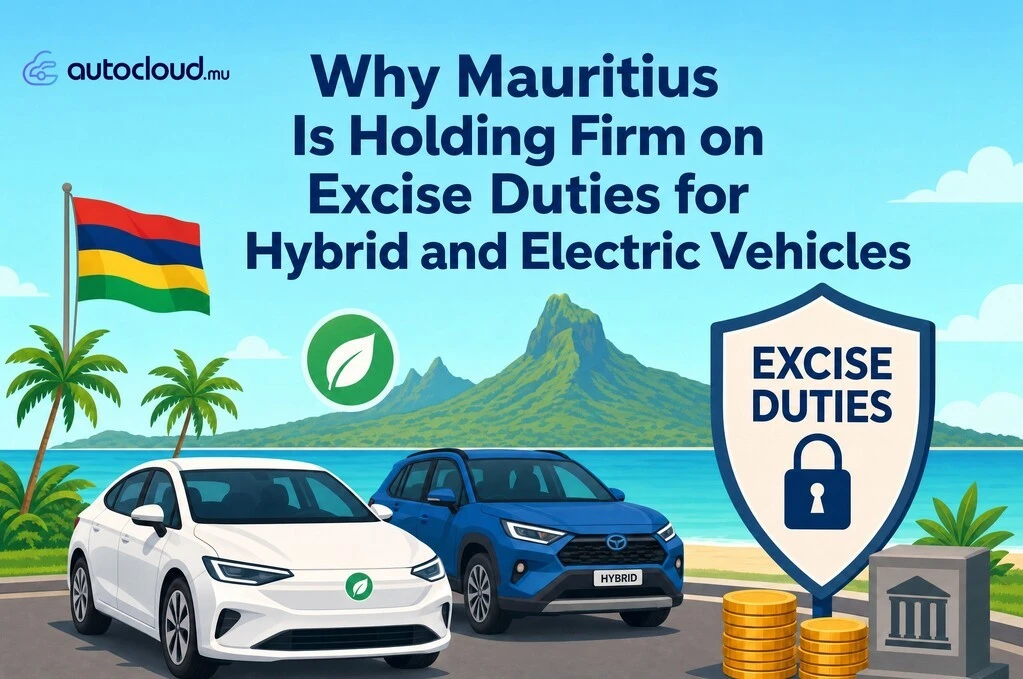
When the 2025-2026 budget reintroduced excise duties on hybrid and electric vehicles, some motorists hoped the measure might be softened over time. The government has now signalled that the duties are here to stay.
During the post-budget debriefing on Saturday 4 July, Junior Minister of Finance Dhaneshwar Damry set out the reasons for maintaining these duties. His explanation focused less on revenue and more on how Mauritius generates the electricity that powers its vehicles.
The emissions argument
Damry noted that the transport sector accounts for 21.3% of the country's greenhouse gas emissions, making it the second-largest emitter after electricity generation from coal and heavy fuel oil.
His point was that electrifying the vehicle fleet is not enough on its own if the electricity used to charge those vehicles continues to come from fossil fuels. On that reasoning, the environmental benefit of an electric car depends heavily on how the grid behind it is powered.
Vehicle density on the roads
The Junior Minister also highlighted the pressure on the road network. Mauritius now has around 250 vehicles per kilometre of road, compared with a global average of approximately 90.
That figure places the vehicle tax question in a wider context, linking duty policy not only to emissions but to the sheer number of vehicles the island's roads are being asked to carry.
A longer-term plan
Damry framed the current duties as part of a continued transition to a green economy. He said the government intends to keep expanding renewable energy generation so that electric vehicles are increasingly powered by cleaner electricity.
What the duties currently look like
For anyone planning a purchase, the practical question is what these duties amount to today.
Since 6 June 2025, electric cars up to 180 kW attract 15% excise duty, while those above 180 kW attract 25%. Non-plug-in hybrids are charged between 25% and 75% depending on engine capacity, and plug-in hybrids fall between 15% and 55%. These vehicles had been duty-free since the 2022 budget.
The changes extend beyond hybrids and EVs. Conventional petrol and diesel vehicles now face excise and customs duties ranging from 45% to 100%, and the Rs 200,000 rebate under the Negative Excise Duty Scheme was withdrawn from 30 June 2025. You canfind out more about how customs duty, excise duty and VAT each apply in our detailed guide.
Where this leaves motorists
The government's position is that hybrid and electric vehicles remain part of the country's future, but that duty concessions will not return while the grid still relies heavily on coal and heavy fuel oil. For buyers, that means understanding the full cost of a vehicle before committing, rather than assuming an electric or hybrid model carries an automatic tax advantage.
AtAutoCloud.mu, we help buyers and sellers make sense of exactly these changes, from valuations and import assistance to finance and insurance, so you can make your next move with the full picture in front of you.
More Articles
![The Road Traffic (Amendment) Act 2026: What Has Changed and What It Means for You]()
The Road Traffic (Amendment) Act 2026: What Has Changed and What ...
When we last covered this, the new road traffic measures were still proposals. They are now law.The Road Traffic (...Read more![Up, Down or Holding? The Honest Outlook for Fuel Prices]()
Up, Down or Holding? The Honest Outlook for Fuel Prices
Scroll through the local press this month and you could be forgiven for bracing yourself at the pump. Headlines have ...Read more![Speed Limits and Drink-Driving Limits in Mauritius: A Quick Guide for Drivers]()
Speed Limits and Drink-Driving Limits in Mauritius: A Quick Guide ...
Knowing the limits on Mauritian roads is the simplest way to stay safe, avoid a fine and keep your licence. ...Read more