New Cars
 Used Cars
 Rentals
 Boats
Boats Motorbike
 Utility
 Services
 News & Review
How Much Is Import Duty on Vehicles in Mauritius?
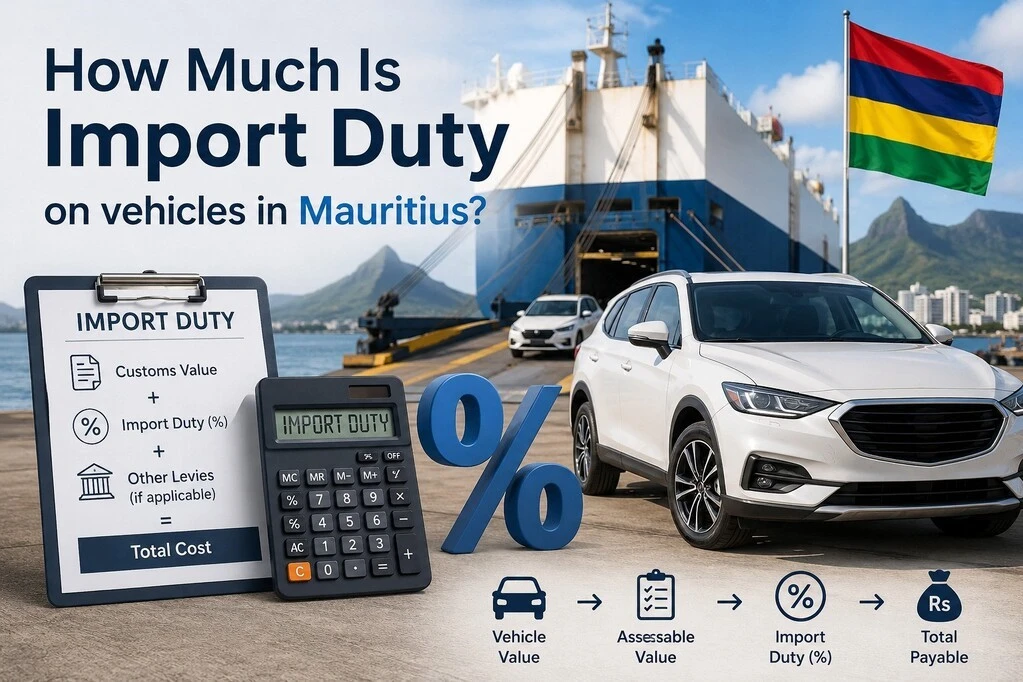
If you have ever wondered why cars cost so much more in Mauritius than they do elsewhere, the answer lies in a layered system of import taxes that can more than double the original price of a vehicle. The 2025-2026 national budget, effective from 6 June 2025, overhauled this system significantly, and whether you are planning to import a car, buy locally, or simply make sense of the market, understanding how these duties work is essential.
At AutoCloud.mu, we help individuals and businesses navigate the complexities of vehicle imports and valuations in Mauritius, so let us walk you through exactly what changed and what it means for you.
How Vehicle Import Taxes Work in Mauritius
Every imported vehicle in Mauritius is subject to three compounding layers of tax:
Customs duty: charged on the CIF value (Cost, Insurance, and Freight) of the vehicle at the port
Excise duty: a separate charge based on engine size, fuel type, and vehicle value
VAT: applied at the standard 15% rate on the duty-inclusive subtotal
Because each layer is calculated on a subtotal that already includes the previous charge, the final landed cost of a vehicle can feel dramatically removed from its original purchase price.
What Changed in June 2025
The 2025-2026 budget introduced three major changes effective 6 June 2025:
Excise and customs duties on conventional petrol and diesel vehicles increased to between 45% and 100%, nearly doubling for some vehicle classes
Excise duty was reintroduced on hybrid and electric vehicles, which had been duty-free since the 2022 budget
The Negative Excise Duty Scheme, which gave individual EV buyers a Rs 200,000 rebate, was abolished from 30 June 2025
These changes raise the cost of importing any new vehicle into Mauritius, regardless of fuel type.
Excise Duty Rates by Vehicle Type (2025)
Conventional Petrol and Diesel Cars
Excise duty on standard passenger cars is now calculated on engine capacity as follows:
Up to 1000 cc: lower end of the 45%-100% range
1001 cc to 1600 cc: mid-range duty
1601 cc and above: upper end, approaching 100%
As a worked example, a Toyota Corolla 1.5L imported new with a CIF value of Rs 1,000,000 produces an approximate tax stack of:
CIF value: Rs 1,000,000
Customs duty (approx. 30%): Rs 300,000 - subtotal Rs 1,300,000
Excise duty (approx. 55%): Rs 715,000 - subtotal Rs 2,015,000
VAT at 15%: Rs 302,250
Final landed cost: approximately Rs 2,317,250
Electric Vehicles (EVs)
From 6 June 2025, electric vehicles are subject to tiered excise duty based on motor power output:
Up to 180 kW: 15% excise duty
Above 180 kW: 25% excise duty
Models taxed at 15% (under 180 kW): BYD Atto 3, Hyundai Kona Electric, Nissan Leaf, MINI Cooper SE Hatchback
Models taxed at 25% (above 180 kW): BMW iX3, Mercedes EQS, Kia EV6
A Rs 2,000,000 electric car under 180 kW now incurs around Rs 300,000 in excise duty with no rebate available. Combined with the abolished Rs 200,000 rebate, buyers face an effective cost increase of Rs 500,000 or more compared to the pre-June 2025 position.
Plug-in Hybrid Electric Vehicles (PHEVs)
Excise duty range: 15% to 55%
Rate is determined by the size of the petrol engine component
Smaller petrol engine = lower rate
PHEVs remain the most duty-efficient electrified option currently available in Mauritius
Standard (Non-Plug-in) Hybrid Vehicles
Excise duty range: 25% to 75%
Rate is determined by engine capacity
Previously enjoyed a significant duty advantage over conventional petrol equivalents - that advantage has now been eliminated
Toyota RAV4 Hybrid: now starts at approximately Rs 3,190,000 in Mauritius
Pick-Up Trucks and Vans
Conventional double-cab pick-ups: duties at the upper end of the 45%-100% range
Electric and hybrid vans, pick-ups, and private buses: now subject to excise duty aligned with conventional equivalents
Policy intent: to discourage use of light commercial vehicles as personal car alternatives
Motorcycles
Duty rates are more modest than for cars and scale with engine size
Electric motorcycles attract lower duty rates than electric cars in some categories
Best suited for short-distance commuters seeking a lower overall cost of entry
Classic, Vintage, and Museum Vehicles
This category is particularly relevant for collectors and enthusiasts, and it is an area where AutoCloud has hands-on experience guiding imports from start to finish.
Cars and spare parts imported specifically for exhibition in a registered motor museum remain fully exempt from duty
Classic and vintage vehicles registered for personal use benefit from a fixed annual motor vehicle licence (MVL) of Rs 3,000
Importation of classic and vintage vehicles for personal use is still subject to standard customs and excise procedures
The duty exemption for museum vehicles is a meaningful saving given the values involved, but the documentation and registration requirements are specific. For personal-use classic imports, the low annual MVL is an attractive ongoing saving, though buyers should factor the standard import duty stack into their total cost of acquisition from the outset.
If you are considering bringing a classic or vintage vehicle into Mauritius, AutoCloud.mu can walk you through the process and ensure the right classifications are applied from day one.
Duty Exemptions and Concessions
Two main concession categories remain available to eligible public sector employees:
100% duty-free exemption: available to certain civil servants, parliamentarians, and senior officers; generally renewable every 5 to 7 years
70% duty concession: available under the PRB Report 2021; claimable once in a career; capped at engine capacities up to 1,400 cc
Beneficiaries opting for a higher engine capacity than their entitlement must pay the proportional duty difference. AutoCloud.mu regularly assists clients in identifying which concession applies to them and preparing the required documentation before importation.
How Duty Is Calculated on Second-Hand Imports
For second-hand vehicles - predominantly sourced from Japan - excise duty is calculated on the FOB (Free on Board) value, reduced as follows:
9% reduction for the first month of use
1% reduction for each subsequent month
Maximum reduction capped at 50%
The Mauritius Revenue Authority's Online Second-Hand Vehicle Valuation System provides an accessible starting point for estimating the assessed FOB value of a specific vehicle before committing to a purchase.
What This Means for the Second-Hand Market
Higher duties on new imports have a direct effect on locally owned used vehicles. As the cost of bringing a new car into Mauritius rises, the relative value of second-hand vehicles already on the island increases.
For sellers, existing vehicles are likely to hold their value better than in previous years. For buyers, the used market offers a cleaner cost picture, free from the compounding layers of import taxation - and with the abolition of registration duty on local pre-owned sales, that picture has become even more attractive.
Getting It Right Before You Import
The duty framework in Mauritius is detailed, and rates vary depending on exact vehicle classification, engine specifications, and the applicable valuation method. Errors at the customs stage can be costly and difficult to reverse.
If you are considering importing a vehicle, or simply want to understand what your options look like under the new regime, AutoCloud.mu can help you work through the numbers before you commit. Reach out to our team today for a clear, accurate assessment tailored to your specific situation.
More Articles
![Petrol Prices Climb Again: The 14 August 2026 Increase at a Glance]()
Petrol Prices Climb Again: The 14 August 2026 Increase at a Glance
If your last fill-up felt pricier, you were not imagining it. From 14 August 2026, petrol has gone up again. Here are ...Read more![A Market Under Pressure: Why Fewer Mauritians Are Buying Cars in 2026]()
A Market Under Pressure: Why Fewer Mauritians Are Buying Cars ...
The new car market continues to lose momentum, and the figures for the first seven months of 2026 suggest the slowdown ...Read more![Strong Demand, Deeper Choice: Mauritius's Automotive Market Mid-2026]()
Strong Demand, Deeper Choice: Mauritius's Automotive Market Mid-2026
Mauritius keeps adding vehicles to its roads, and the latest numbers show no sign of a slowdown. At the end ...Read more