New Cars
 Used Cars
 Rentals
 Boats
Boats Motorbike
 Utility
 Services
 News & Review
Why Modern Cars Forgot How to Be Interesting. And Whether We Can Go Back.
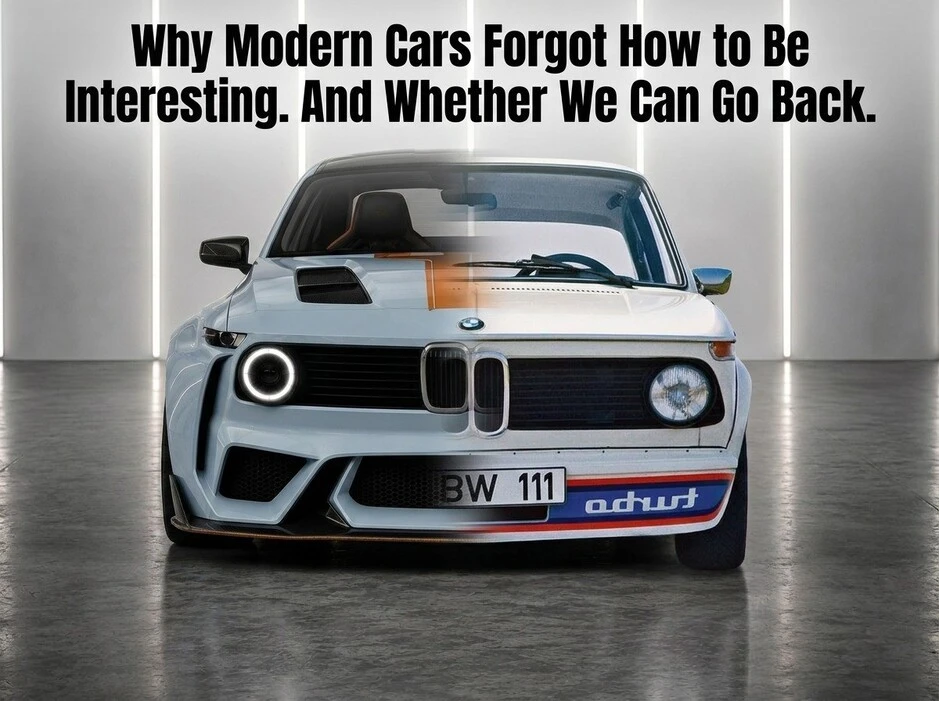
The BMW 2002 is one of those rare cars that didn't just transport people. It transported an entire company.
Back in the late 1960s, BMW was still finding its identity. Then along came a compact, lightweight, slightly mischievous machine that could embarrass much bigger and more expensive cars on a twisty road. The 2002 Turbo even arrived with "turbo" written backwards across its front spoiler, so drivers ahead could read it in their mirrors. If ever there was a car with a sense of humour, that was it.
The Numbers Don't Lie
The original 2002 measured just 4,230 mm long and weighed less than a tonne. The current BMW 2 Series Coupe, its closest spiritual descendent, stretches beyond 4,432 mm and tips the scales at up to 1,685 kg. That's a sports coupe that is longer than the family saloons it once left behind. Parking bays haven't grown to match. Your reversing sensors are working harder than ever for a reason.
So What Happened?
The designers didn't suddenly lose their taste. Modern cars are shaped by crash safety standards, aerodynamic targets, emissions regulations, global market demands and battery platforms that weigh as much as a small horse. Over the past 30 years, the average passenger vehicle has become four inches wider, ten inches longer, eight inches taller and roughly 1,000 pounds heavier. None of that bulk comes from indulgence. It comes from obligation.
Then the SUV boom arrived, consumers followed, and manufacturers followed the consumers. Even coupes started borrowing the inflated proportions. The visual restraint that cars like the 2002 practically invented got buried under black plastic cladding and oversized grilles.
Can We Go Back?
Modern BMW designers aren't sketching on napkins in a shed. They answer to regulators, accountants, marketing departments and four different continents simultaneously. The talent is still there. The freedom often isn't. And yet there are quiet signs of a shift. The success of lighter, more focused cars like the GR86 and the Alpine A110 suggests that buyers haven't entirely given up on the idea of a car that prioritises feel over footprint. Manufacturers are starting to notice.
What the 2002 proved, and what still holds true, is that a car doesn't need to be large to be significant. It needs to be honest. The appetite for that kind of car never really went away. It just got drowned out for a while.
If you're in the market for something that actually suits Mauritian roads rather than swallows them whole, browse what's available now onAutoCloud. The right car rarely needs to be the biggest one on the page.
More Articles
![The Road Traffic (Amendment) Act 2026: What Has Changed and What It Means for You]()
The Road Traffic (Amendment) Act 2026: What Has Changed and What ...
When we last covered this, the new road traffic measures were still proposals. They are now law.The Road Traffic (...Read more![Up, Down or Holding? The Honest Outlook for Fuel Prices]()
Up, Down or Holding? The Honest Outlook for Fuel Prices
Scroll through the local press this month and you could be forgiven for bracing yourself at the pump. Headlines have ...Read more![Speed Limits and Drink-Driving Limits in Mauritius: A Quick Guide for Drivers]()
Speed Limits and Drink-Driving Limits in Mauritius: A Quick Guide ...
Knowing the limits on Mauritian roads is the simplest way to stay safe, avoid a fine and keep your licence. ...Read more