New Cars
 Used Cars
 Rentals
 Boats
Boats Motorbike
 Utility
 Services
 News & Review
A tougher stance on drink and drug driving in Mauritius, but will it actually help?
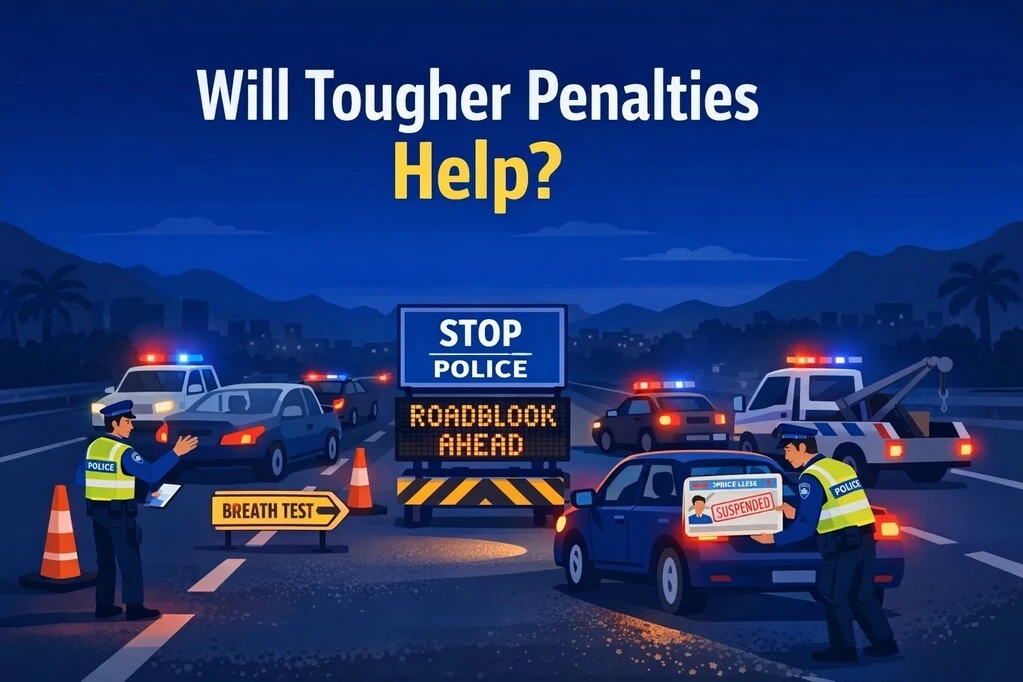
Mauritius has started 2026 with a worrying spike in drink and drug driving cases, and Government is moving towards a firmer response. Cabinet has approved drafting instructions for legal amendments that could bring two major changes.
One is systematic vehicle seizure when a driver tests positive for alcohol and or drugs. The other is a process where the Commissioner of Police could seek immediate suspension of a driver’s licence through an ex parte application before a judge in chambers, rather than waiting for the usual timelines. The amendments are expected to go to Parliament in the coming months.
Police statistics reported in local media suggest the concern is not theoretical. From 1 January to 12 February 2026, 178 drivers tested positive for drugs and 411 motorists were caught drink driving.
Will seizure and instant suspension reduce crashes?
It might, but only if it is fast, consistent, and applied fairly. A deterrent works when drivers believe they will be caught and that consequences will follow immediately. Seizure and rapid suspension aim to do exactly that by removing both the driver and the vehicle from the road.
The risk is execution. Clear rules will matter, especially around situations where the driver is not the owner, or where the vehicle is leased or part of a company fleet. If the process feels uneven or delayed, the deterrent effect weakens.
What should be strengthened before relying on this as the main solution?
A tougher law is only one lever. If the objective is fewer deaths and serious injuries, other options should be pushed hard in parallel.
More visible, consistent roadside checks at peak risk times
Enforcement works best when drivers feel they are likely to be stopped, particularly at night, on weekends, and around major events.
Faster consequences from stop to sanction
Delays dilute deterrence. Speeding up admin and court processes can make every arrest count more.
Target repeat offenders with practical tools
Measures like ignition interlocks for repeat drink drivers are used internationally to physically prevent reoffending, rather than relying solely on policing.
Treatment and rehab pathways for dependency-linked cases
This is not about going soft. It is about reducing reoffending where addiction is part of the pattern.
Employer and fleet accountability
A big portion of driving happens through work vehicles. Stronger fleet policies can reduce risk quickly.
Better late-night alternatives
When the alternative to driving is expensive or inconvenient, people make bad decisions. Practical options reduce temptation.
Where the penalty points system fits
The penalty points system came into force on 31 January 2026 and is meant to shape everyday driving behaviour over time. But drink and drug driving is often impulsive and high-impact, so immediate consequences tend to matter more.
What AutoCloud.mu is watching
If these measures become law, motorists will need clear, practical guidance on what triggers seizure, what happens to the vehicle, and how the process works in real life. That is the sort of plain-language breakdown AutoCloud.mu will keep tracking and publishing as the situation develops.
The big question is simple. Will tougher penalties change behaviour on the ground, or do we need to focus just as much on alternative solutions?
More Articles
![The Roadblock Lottery: Why One in Four Drivers Lost This Weekend]()
The Roadblock Lottery: Why One in Four Drivers Lost This ...
If you were out on the roads between Saturday 3 and Monday 5 October, there is a good chance you met a ...Read more![Skip the Queue: Traffic Fines Go Online From 30 October]()
Skip the Queue: Traffic Fines Go Online From 30 October
Few things sour a morning quite like a Fixed Penalty Notice. Until now, settling one has usually meant taking time ...Read more![The Road Traffic (Amendment) Act 2026: What Has Changed and What It Means for You]()
The Road Traffic (Amendment) Act 2026: What Has Changed and What ...
When we last covered this, the new road traffic measures were still proposals. They are now law.The Road Traffic (...Read more