New Cars
 Used Cars
 Rentals
 Boats
Boats Motorbike
 Utility
 Services
 News & Review
Petrol Prices Climb Again: The 14 August 2026 Increase at a Glance
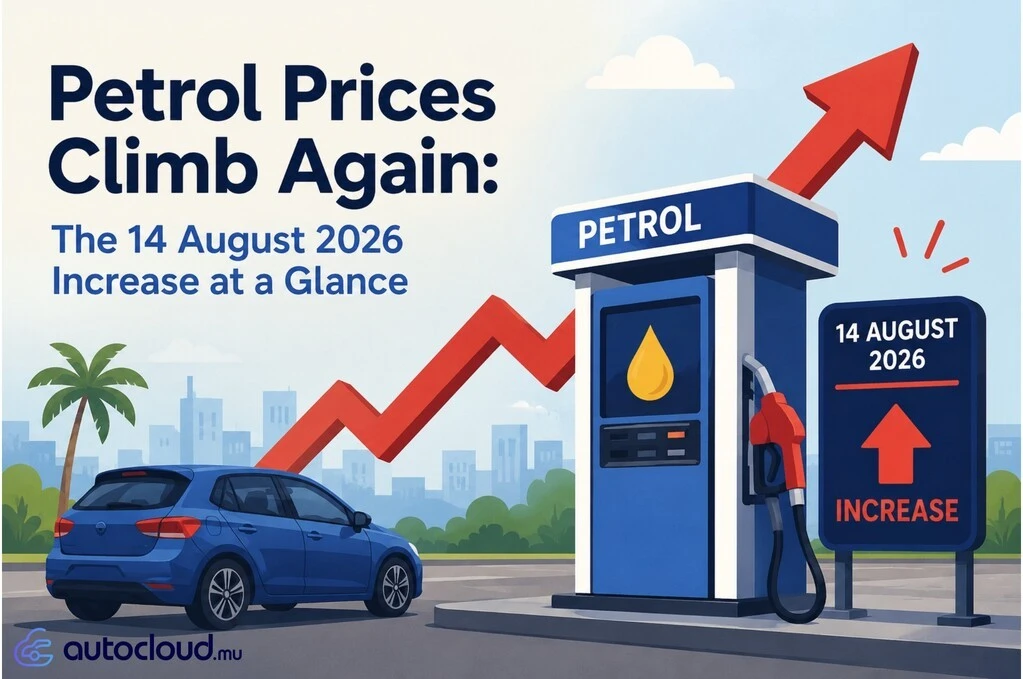
If your last fill-up felt pricier, you were not imagining it. From 14 August 2026, petrol has gone up again. Here are the key takeaways for Mauritian motorists. Petrol (Mogas) has risen from Rs 64.25 to Rs 70.65 per litre, an increase of Rs 6.40, or just under 10 per cent. Diesel has been held steady at Rs 71.25, sparing buses, hauliers and bakeries a second blow. In real terms, a full tank now costs roughly Rs 256 to Rs 416 more depending on its size, and with inflation at 4.4 per cent, lower-income households feel it most. Three forces combined. World reference prices for petrol climbed to around US$1,032.80 per metric tonne. The rupee, applied at about Rs 47.80 to the US dollar, makes every imported barrel dearer in local currency. And the Price Stabilisation Account, the cushion meant to soften price swings, is now running an estimated deficit of Rs 3.50 billion, up from Rs 1.50 billion in March. With that buffer worn thin, a rise became hard to avoid, though a 10 per cent cap kept it below the calculated Rs 9.48. Yes, on a few fronts. Global forecasts point downward, with the US Energy Information Administration expecting Brent crude to ease toward US$58 a barrel in 2026 and US$53 in 2027 as supply outpaces demand. Holding diesel steady protects transport and food costs. And the steady shift to electric and hybrid vehicles means more drivers are insulating themselves from the next price swing altogether. Fuel prices are beyond any driver's control, but the vehicle you choose is not. A more efficient petrol car, a hybrid or an electric model softens every future increase. At AutoCloud.mu, you can compare vehicles across fuel types, efficiency and running costs, so your next car makes the price at the pump matter a little less.What Has Changed
What Has Caused the Increase
Is There Any Light on the Horizon
The Smart Takeaway
More Articles
![The Road Traffic (Amendment) Act 2026: What Has Changed and What It Means for You]()
The Road Traffic (Amendment) Act 2026: What Has Changed and What ...
When we last covered this, the new road traffic measures were still proposals. They are now law.The Road Traffic (...Read more![Up, Down or Holding? The Honest Outlook for Fuel Prices]()
Up, Down or Holding? The Honest Outlook for Fuel Prices
Scroll through the local press this month and you could be forgiven for bracing yourself at the pump. Headlines have ...Read more![Speed Limits and Drink-Driving Limits in Mauritius: A Quick Guide for Drivers]()
Speed Limits and Drink-Driving Limits in Mauritius: A Quick Guide ...
Knowing the limits on Mauritian roads is the simplest way to stay safe, avoid a fine and keep your licence. ...Read more