New Cars
 Used Cars
 Rentals
 Boats
Boats Motorbike
 Utility
 Services
 News & Review
Mauritius Raises the Bar on Distracted Driving: Tougher Penalties Take Effect Today
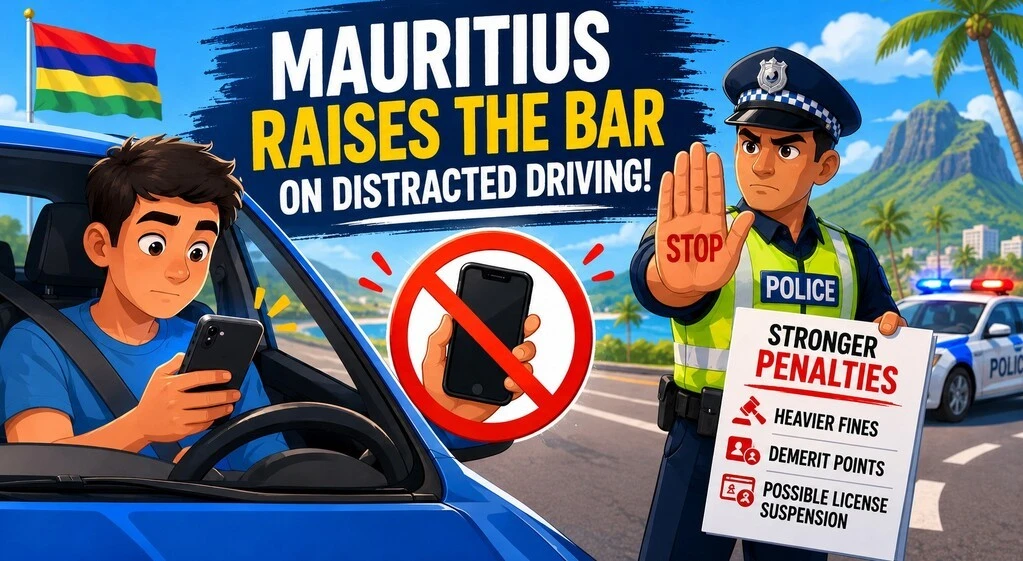
Driving requires your full attention. It sounds obvious, yet the temptation to glance at a notification or fire off a quick message whilst behind the wheel remains a daily reality for many. As of today, 10 June 2026, Mauritius has made that habit considerably more costly. The number of penalty points for using a handheld phone or microphone whilst driving has increased from a range of 3 to 6 points, to a new range of 5 to 10 points, effective from 10 June 2026. This follows the publication of the Road Traffic (Amendment of Schedule) (No. 2) Regulations 2026 in the Government Gazette on 6 June, with Cabinet formally noting the regulation at its meeting on 5 June. The existing Rs 3,000 fine remains in place alongside the points. At the upper end of the new range, a single offence could now account for a significant portion of the points threshold required for licence suspension. That is not a consequence to take lightly. The decision comes as authorities observe that many road users continue to handle their phones whilst driving, despite the penalty points system already being in place since 31 January 2026. A preliminary assessment by the Traffic Management and Road Safety Unit did show a stabilisation of road safety indicators over that period, along with a reduction in certain road fatalities, but phone use behind the wheel has clearly remained persistent enough to warrant a stronger response. The objective is not purely to punish, but to modify behaviour before a tragedy occurs. Road safety specialists note that just a few seconds of inattention is sufficient to cause a serious or fatal collision. Tougher penalties for phone use are reasonable, but they are one piece of a much larger puzzle. Stiffer fines mean little if the person behind the wheel should not legally be there in the first place, and the prevalence of unverified and fraudulent driving licences remains an uncomfortable reality on Mauritian roads. Add to that the routine disregard for safe following distances, overtaking on solid white lines, and passing on blind corners and crests, and it becomes clear that the problem runs deeper than any single regulation can address. Which raises a fair question: why are we not seeing boots on the ground actively penalising these behaviours? Overtaking on a solid line or launching past a vehicle on a blind corner are not technical infractions that require sophisticated detection equipment. They happen in plain sight, every day, on roads across the island. These are precisely the kinds of dangerous decisions that cause head-on collisions, and they represent low-hanging fruit for any enforcement effort serious about reducing fatalities rather than simply increasing fine revenue. Penalties change what people risk. Visible, consistent enforcement of the most dangerous driving behaviours is what changes what people actually do. Bluetooth systems integrated into a vehicle and hands-free speaker devices remain permitted. What is prohibited includes holding a phone for any reason whilst the engine is running, reading or sending messages, and wearing wired or wireless earphones of any kind. AtAutoCloud, we think it is worth knowing the road you are driving on, in every sense. As enforcement continues to tighten, many listings onAutoCloud.mu now highlight safety features and compliance details, making it easier to buy and sell with confidence.What Has Changed?
Why the Escalation?
A Welcome Step, But Only One of Many
What Drivers Need to Know
More Articles
![The Roadblock Lottery: Why One in Four Drivers Lost This Weekend]()
The Roadblock Lottery: Why One in Four Drivers Lost This ...
If you were out on the roads between Saturday 3 and Monday 5 October, there is a good chance you met a ...Read more![Skip the Queue: Traffic Fines Go Online From 30 October]()
Skip the Queue: Traffic Fines Go Online From 30 October
Few things sour a morning quite like a Fixed Penalty Notice. Until now, settling one has usually meant taking time ...Read more![The Road Traffic (Amendment) Act 2026: What Has Changed and What It Means for You]()
The Road Traffic (Amendment) Act 2026: What Has Changed and What ...
When we last covered this, the new road traffic measures were still proposals. They are now law.The Road Traffic (...Read more