New Cars
 Used Cars
 Rentals
 Boats
Boats Motorbike
 Utility
 Services
 News & Review
The Diminishing Returns of Speeding
Speeding feels like it saves real time. It usually does not. Once you do the maths, the extra 20 km/h you fight for at the top of the dial buys you almost nothing, while the risk and the fuel bill climb hard. Here is the proof.
The problem is your speedometer
A speedometer shows speed in even steps, so 100 km/h looks twice as useful as 50 km/h. It is not. What you actually care about is arrival time, and arrival time does not move in a straight line. It bends, and it bends fast.
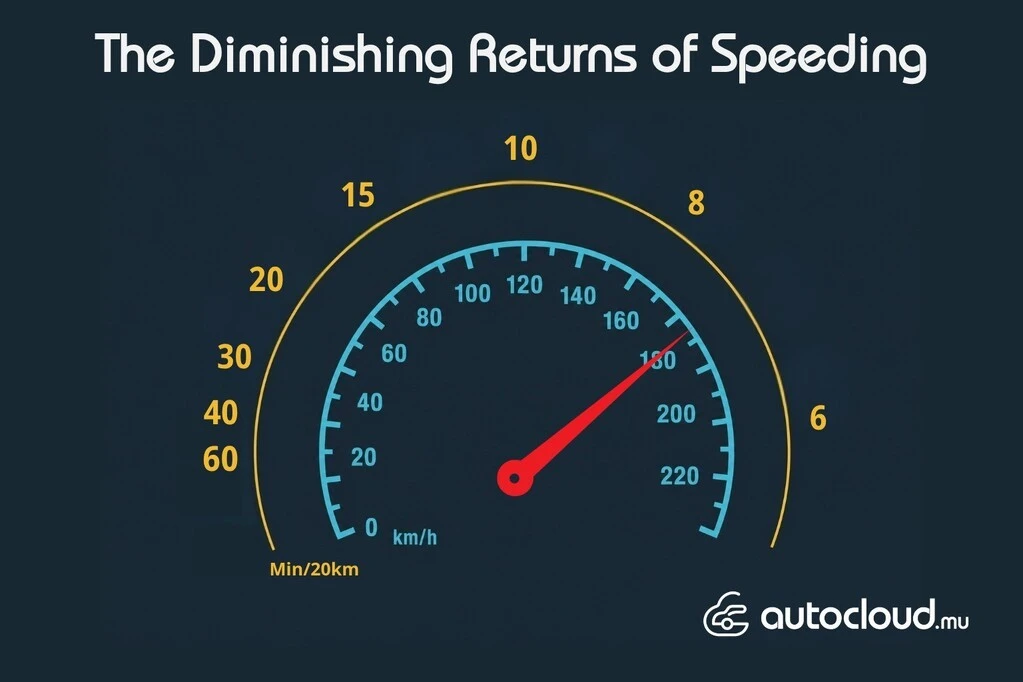
So flip the gauge around. Instead of showing speed, show the minutes needed to cover a fixed distance. Use 20 kilometres, a realistic commute or errand run. Call it the Paceometer. Look at the poster on this page: the inner ring is your speed, the outer ring is the minutes that speed actually costs you over 20 kilometres. Find your speed on the inside, read your pace on the outside, and watch how little the outer numbers move once you are already going fast.
Low speeds: every km/h counts
At the bottom of the dial, pushing harder genuinely pays.
At 30 km/h, 20 kilometres takes 40 minutes. At 50 km/h it takes 24. That is 16 minutes saved for 20 km/h more. Go from 40 to 60 km/h and you still save 10 minutes. This is why a school zone or a jammed high street feels so slow. Down here, speed converts straight into time.
High speeds: you are chasing nothing
At the top of the dial, where drivers actually break the law, the payoff collapses.
At 100 km/h, that same 20 kilometres takes 12 minutes. At 120 km/h it takes 10. Your reward for an extra 20 km/h is two minutes. Push from 110 to 130 and you save under two minutes.
The minute that costs the most
The hard overtake, the sprint between two lights, the push from 110 to 130 on a busy motorway: on a normal trip, all of it saves a minute or two at most. That is the time it takes a kettle to boil.
Now count what those minutes cost you. Stopping distance rises with the square of speed, so a small increase near the top of the range adds a lot of braking distance and leaves far less room to react. And the fuel bill jumps. Going from 110 to 130 km/h burns roughly 20 to 25 percent more fuel over the same distance, because aerodynamic drag rises with the square of your speed. You are paying about a quarter more at the pump, and taking on real danger, to shave off a minute or two.
Bottom line
Next time the road tempts you past the limit, picture the Paceometer. At high speed you are trading a big jump in risk and fuel for a minute or two you will not notice. Ease off, arrive calm, keep the maths on your side.
Looking to upgrade to a car with cruise control, or radar, look no further than AutoCloud.mu
More Articles
![Up, Down or Holding? The Honest Outlook for Fuel Prices]()
Up, Down or Holding? The Honest Outlook for Fuel Prices
Scroll through the local press this month and you could be forgiven for bracing yourself at the pump. Headlines have ...Read more![Speed Limits and Drink-Driving Limits in Mauritius: A Quick Guide for Drivers]()
Speed Limits and Drink-Driving Limits in Mauritius: A Quick Guide ...
Knowing the limits on Mauritian roads is the simplest way to stay safe, avoid a fine and keep your licence. ...Read more![KOREK! What the Government's New App Means for Motorists]()
KOREK! What the Government's New App Means for Motorists
Mauritius now has a single digital gateway to public services, and the first thing it does for motorists is put ...Read more